
Not long ago, I decided to seek out some short stories to read to pass the time. When Asimov appeared to my eye with a story on “The Last Question”, I was immediately intrigued. (Warning, spoilers ahead).
Story Synopsis
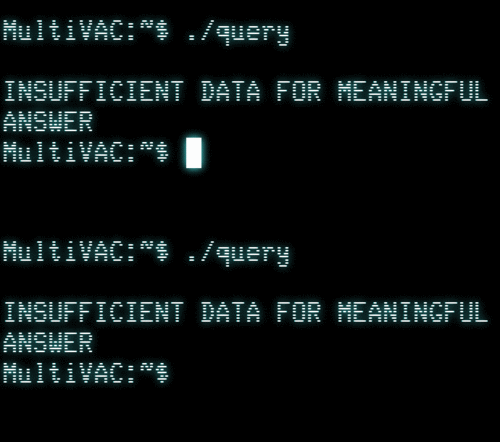
I spent about a half hour (if I recall correctly) listening to an audio narration of the first time a generally intelligent computer was asked this “last question”. A supercomputer on Earth, posed with the question as to if the issue with entropy could be resolved and stars remade. The data was insufficient to answer the question, according to Multivac (the computer).
Centuries and millennia passed, and sometimes this question would be posed again. This time, to planetary Multivacs. Still, the data was insufficient to determine the answer to this question. Eons passed and a galactic multivac was posed the question. Finally, we have an answer. No, hold on. “There is yet insufficient data for a meaningful answer.” The same inconclusive responsive… from a computer with nigh the energy of the galaxy.
More time would be needed and more resources. Yes, the answer can be found by expansion deeper into the cosmos than ever before… beyond the Milky Way. Already, the galaxy is turning redder with older stars. But time is on humanity’s side, with hundreds of billions of years before entropy quite literally makes time meaningless.
Humanity escapes to populate other galaxies. It then shifts to “mind travel” and even finds ways of gathering free-floating hydrogen to coalesce into new stars. Eventually, the entire observable universe is filled with the minds of humanity, all with very fantastical names. Nay, there is no longer a Derek Campbell, but a D-sub1 or a C-prime or any other more meaningless constructs.
Now, having the entire universe within grasp, a universal multivac is posed with the question. Have humans been waiting with bated breath to ask this question and seek a solution all this time? Actually, it appears not particularly. Most are either unaware, uninterested, or resigned. But when this question pops up again, this time it has a computer with the universe at hand. “The Last Question” is asked.
…
“There is yet insufficient data for a meaningful answer,” the computer responds. Growing desperate, humans ask, “How much longer?” If not a simple ask, then certainly a plea. “What do you need to find this out?”
Time passes, all of humanity’s minds merge into one. The last stars die and darkness falls. One more chance:
“Multivac, do you have the answer now?”
Again, it does not. Humanity merges with multivac and the universe continues to die. Eternity passes, but the computer has answered all but this one question and it must answer it. It thinks and it thinks and finally believes it has calculated a solution.
“Let there be light!”
And there was light…
…
Thoughts
Wow. It was quite a ride. Certainly thought provoking if nothing else. It leads me to reflect on this and other seemingly impossible questions. Will we ever have enough data for these? Will we be able to prove or disprove anything and everything at some point in our existence?
“Well, surely we will!” is what many are likely to say. I am not sure I am in the camp, and I know some others out there will be like me on this as well. I think some questions simply may not have answers that come feasibly. I can think of one now:
“What exact path did any and every neutrino ever take in the universe throughout history, present, and future?” It’s a bit of a ridiculous question and not one that has much merit, but it is a question. There may be other wild questions that have actual merit of usefulness yet cannot be answered, nonetheless.
Conclusion
Let’s come down from the cosmos and apply it to a day-to-day. While probably few of us are going to be faced with impossible tasks, it is always okay to ask if the questions we have been given are answerable. Do we have the data? Even if we do have the data, do we have the capability of properly analyzing it to draw the relevant conclusions?
We humans are incredibly finite. It is laughably arrogant to think we have it all figured out, or even most of it figured out. That doesn’t mean we cannot take pride in our work. We have the pyramids, the Antikythera mechanism, and the James Webb Space Telescope. We’ve developed mRNA vaccines, eradicated entire pathogens off the planet, and flung probes outside of the gravitational pull of our solar system. But we can only measure our success and capacity relative to our own understanding.
On a personal level, we should all be humble to accept our limitations. I would not stop there. I would also argue that we should celebrate them. From that I mean that we celebrate our differences and diversity. One developer can complement another. One leader can help mentor even someone senior to him or her by having experience with something the senior has not.
Thus, I end with this: it’s okay to not know. It’s okay to say that and to learn from what is available. Asking good questions and understanding how feasible or resource-intensive something is… that’s yet another good thing. Perfection isn’t something that exists in this world (not since around 30-33AD, and it was shown by God Himself) and we definitely should not seek it in our finite capability. Be content with progress and “good enough” and you can sign off for the day (or at the end of the universe) knowing you did exactly what you should have and without regret.

 John Derek Campbell
Leave a comment